
Fifty leaders. Seven Rs. One evening in Singapore.
On 26 October 2026, Rolling Arrays and ETHRWorld Southeast Asia recognised fifty senior HR leaders from across the region at Pan Pacific Singapore. Each was chosen for their work in one stage of the talent supply chain.
The evening, in seventy seconds.
The room, the masterclass, and the fifty leaders who walked onto the stage one at a time. Turn the sound on.
Creator of the R7 Framework
It took me about 14 years to truly fall in love with HR.
Rolling Arrays started in 2009. Year after year we delivered HR technology projects, and our clients were happy. But one question never got a clear answer. What did all this work do for the business?
In early 2023, I started a newsletter called “HR is NOT a Cost Center”.
After 2 years of writing it, something kept bothering me. Unless we have proven research that HR is not a cost center, it will always be hard to prove the statement.
That gave birth to R7 Framework Research in early 2025. And to be honest, it has given me perhaps the best time of my life.
Almost 18 months of research. 6 research sharing sessions through 2026, in Kuala Lumpur and Singapore. And on 26 October, at R7 Night, we closed the first milestone.
We celebrated the R7 Fifty, 50 leaders from across Southeast Asia, each honored for what they have contributed to one of the seven Rs of R7. We also invited about 100 curated guests who lead across HR, IT, finance and Strategy and showed them the research behind why HR is not a cost center.
A year of R7 conversations, brought into one room.
R7 Fifty closed the 2026 R7 Roundtable series. Six tables across Singapore and Kuala Lumpur, and then one evening to recognise the people doing the work.
Why celebrate the layer beneath the CHRO? An observation from a year of R7 conversations: the people rebuilding the system often remain behind the scenes.Manu Khetan, Founder & CEO, Rolling Arrays
What the latest research reveals about the evolving talent supply chain, and the forces reshaping how organisations build, move and retain talent.Prof. Felix Oberholzer-Gee, Harvard Business School
Each honouree was called to the stage for one R of the talent supply chain, from Recruit to Rehire.
The official unveiling of the R7 Fifty book, followed by the honourees gathering for the R7 Fifty group photograph.
Manu Khetan, Founder & CEO, Rolling Arrays
A curated selection, not an awards entry.
There was no application, no nomination form, no entry fee and no sponsorship. Leaders were identified through research against published criteria.
Each leader is recognised in one R, not in general. The seven Rs come from the R7 Framework, which treats talent as a supply chain rather than a set of disconnected HR processes. Each stage either adds value or leaks it.
- 01The share of A-Players in business-critical roles
- 02How long those A-Players stay in them
Recruit
Source the right people for the role.
Rate
Calibrate role-relative performance ratings.
Retain
Keep A-Players in critical roles.
Redeploy
Move people to roles where they can be A-Players.
Redevelop
Build knowledge and skill to close the gap.
Release
Exit C-Players when no fit exists.
Rehire
Bring back alumni with low time to productivity.
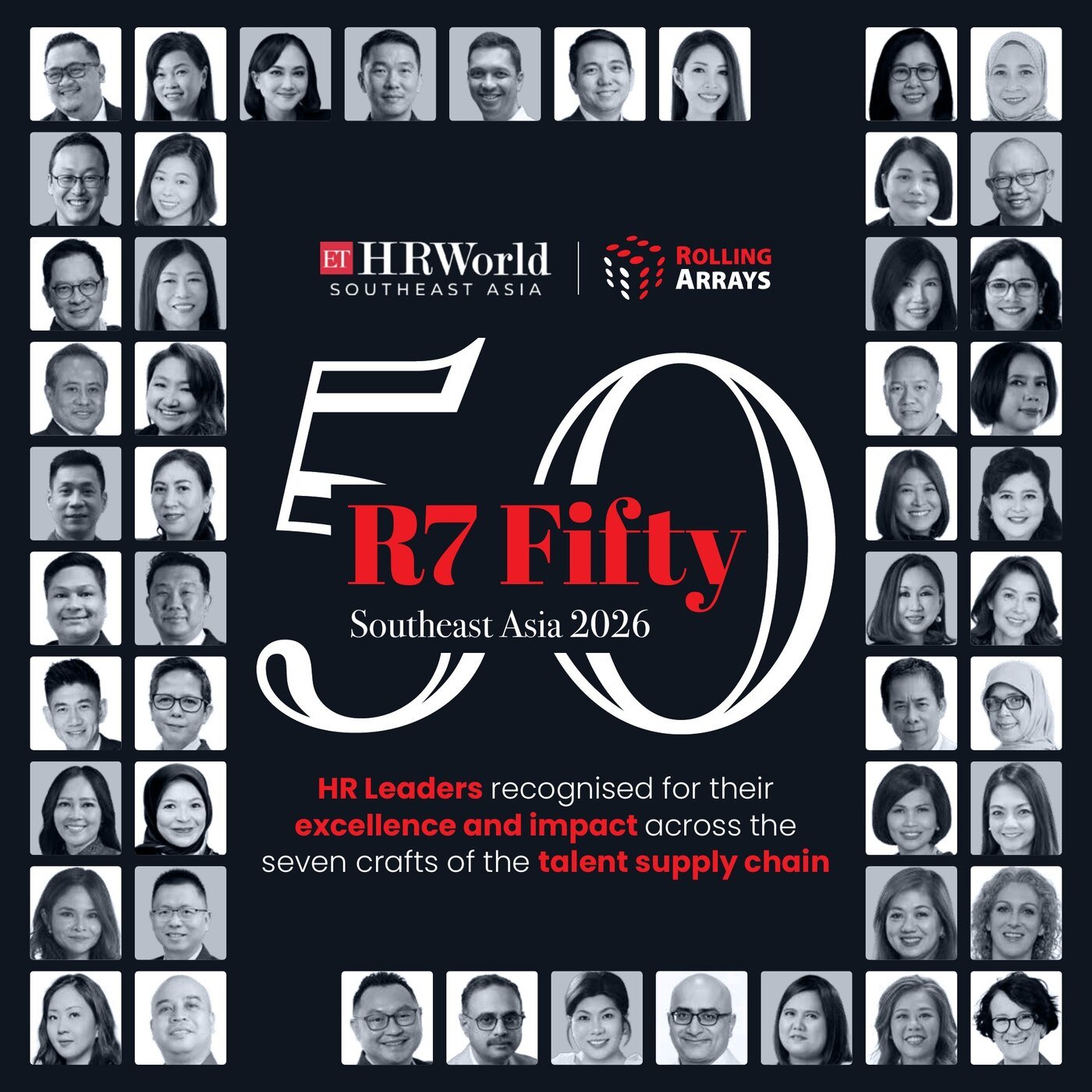
The R7 Fifty, in print.
The fifty honourees are published in a coffee-table book, unveiled on the night.
Each profile sets out the work that earned the recognition, the stage of the talent supply chain it represents, and the leader’s own view of where the function is heading. The book opens with a foreword by Manu Khetan and an editor’s note by Yasmin Taj, Editor, ETHRWorld Southeast Asia.
HR is NOT a Cost Centre. It owns the talent supply chain.
R7 Fifty is a Rolling Arrays and ETHRWorld Southeast Asia initiative, built on the R7 Framework created by Manu Khetan.
R7 research is conducted in collaboration with Prof. Felix Oberholzer-Gee, Harvard Business School. Neither Prof. Oberholzer-Gee nor Harvard Business School played any part in the selection of the fifty, and neither endorses the initiative.